
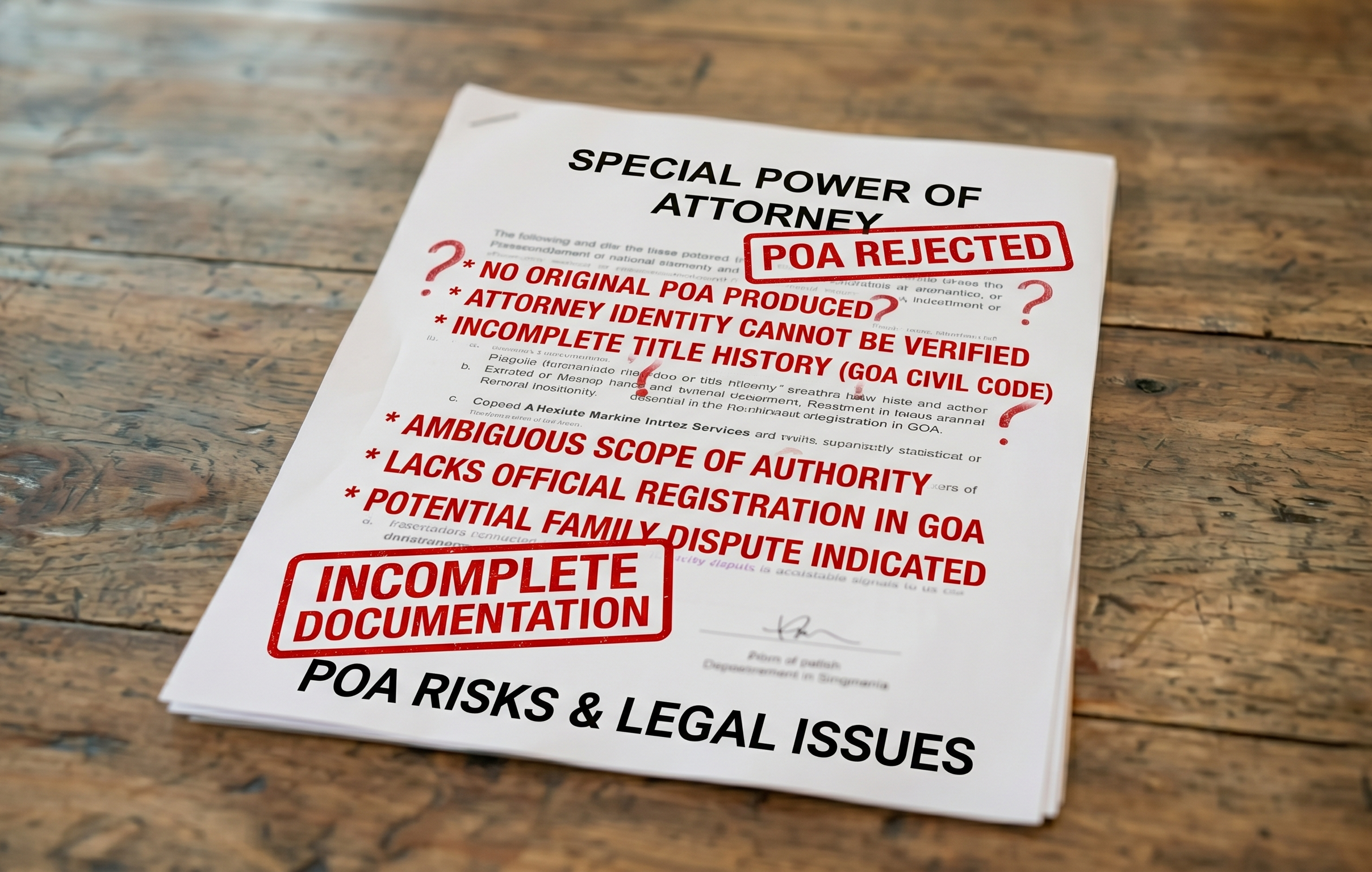
Why Buyers Reject POA Property Sale Goa Deals — And How Sellers Can Fix It
A POA property sale Goa transaction may seem like a simple solution when the property owner is abroad, elderly, unavailable, or unable to attend registration personally. But for today’s buyers, a Power of Attorney sale often raises immediate doubts.
In 2026, buyers, banks, lawyers, and sub-registrars are far more cautious about POA-based property deals. The reason is simple: POA documents have often been misused in India to hide ownership issues, avoid proper registration, move unaccounted money, or sell property without clear authority.
That does not mean every POA transaction is unsafe. A Power of Attorney can be valid and useful when it is properly drafted, legally executed, and used only to support a registered sale deed. But when sellers try to complete a property transfer using only a POA, serious buyers usually walk away.
Here is why buyers reject POA deals in Goa—and how sellers can fix the problem before losing a genuine purchaser.
Why the Supreme Court Frowns Upon POA-Only Sales
A Power of Attorney is not the same as a sale deed.
This is the most important point every seller must understand. A POA only authorizes one person to act on behalf of another. It may allow the attorney holder to sign documents, appear before authorities, collect papers, or complete formalities. But it does not automatically transfer ownership of immovable property.
Ownership must be transferred through a valid, registered sale deed or conveyance deed.
This is why POA-only sales are treated with suspicion. In many cases, people used General Power of Attorney documents as a substitute for sale deeds. Money changed hands, possession was given, and the buyer assumed they had become the owner. But legally, the title remained weak because the transfer was not completed through the correct registered document.
For a serious buyer, this is a major red flag.
If the property was previously transferred through a POA-only arrangement, the buyer may worry that the seller does not have a clean title. Banks may also refuse to finance the transaction because the ownership chain is not properly supported.
For sellers in Goa, the solution is clear: do not market a POA as proof of ownership. Use it only as an authority document, and make sure the final sale happens through a registered sale deed.
Risks for Buyers: Revocation, Death of Owner, and Title Flaws
Buyers reject POA deals because the risks are real. A property may look attractive, the price may seem fair, and the location may be excellent, but if the authority to sell is unclear, the entire deal becomes unsafe.
One major risk is revocation. In many situations, a Power of Attorney can be cancelled by the person who issued it. If the POA was revoked before the sale, the attorney holder may no longer have the right to sign on behalf of the owner.
Another major risk is the death of the owner. A POA usually comes to an end when the person who issued it passes away. If the attorney holder tries to sell the property after the owner’s death, the transaction can be challenged by legal heirs.
Title flaws are another concern. The POA may not mention the property correctly. It may not give specific authority to sell. It may be old, vague, improperly stamped, unregistered, or not authenticated correctly. In NRI cases, the document may require consular attestation, apostille, notarization, or proper validation before it can be used in Goa.
Buyers also worry about fraud. A forged or misused POA can lead to years of legal disputes.
This is why buyers and their lawyers usually check:
- Whether the actual owner is alive and identifiable
- Whether the POA is valid and current
- Whether the POA specifically authorizes sale
- Whether the property description matches title records
- Whether the POA was properly executed and registered where required
- Whether the final sale deed will be signed and registered legally
- Whether payment will go to the rightful owner
These legal risks property Goa buyers face make POA deals difficult unless the documentation is handled correctly.
Risks for Sellers: Misuse and Tax Liabilities
Sellers often think POA risks only affect buyers. That is not true.
A poorly drafted POA can create serious problems for the owner as well. If the attorney holder is given broad or unclear powers, they may misuse the authority. They may negotiate terms without approval, collect money incorrectly, delay communication, or sign documents the seller does not fully understand.
This is especially risky for NRIs, elderly owners, joint owners, and families selling inherited property.
Tax liability is another major issue. Even if someone else signs the documents under POA, the actual owner may still be responsible for capital gains tax, TDS compliance, and related reporting. A POA does not transfer tax responsibility away from the seller.
Payment handling is also important. If the buyer pays the attorney holder instead of the legal owner, disputes can arise later. Sellers should ensure that the payment trail is clear, documented, and routed correctly.
From a property fraud prevention Goa perspective, sellers should never issue a broad General Power of Attorney without understanding the consequences. A safer POA should be limited, specific, and tied to a clearly defined transaction.
A seller should know exactly:
- Who is being appointed
- What powers are being granted
- Whether the attorney can negotiate price
- Whether the attorney can receive payment
- Whether the attorney can sign and register the sale deed
- How long the POA remains valid
- How the seller will monitor the transaction
The more valuable the property, the more careful the seller must be.
When is a POA Actually Necessary and Safe?
A Power of Attorney is not always a problem. In many property sales, it is genuinely useful.
For example, an NRI owner may not be able to travel to Goa for every step of the sale. An elderly seller may appoint a trusted family member to complete registration formalities. A co-owner living outside India may authorize another co-owner to represent them. In these cases, a POA can make the transaction practical.
But safety depends on how the document is prepared and used.
A safe POA should be specific to the property. It should clearly mention the survey number, property description, owner details, attorney details, and exact powers granted. If the attorney is allowed to sign the sale deed, appear before the sub-registrar, or receive payment, the document should say so clearly.
An irrevocable power of attorney Goa document may be useful in certain situations, but sellers should not assume that “irrevocable” automatically means risk-free. It still needs to be legally valid, properly executed, and supported by the correct sale structure.
Most importantly, the final transfer should happen through a registered sale deed. The POA should assist the sale process, not replace the sale deed.
A safer POA-based sale usually includes:
- Proper legal drafting
- Identity verification of owner and attorney
- Correct property description
- Clear authority to execute sale documents
- Valid stamping, registration, notarization, or authentication
- Direct payment trail to the seller
- Registered sale deed execution
- Post-sale mutation and record updates
Used correctly, a POA can support a lawful sale. Used casually, it can destroy buyer trust.
Ensure a Lawful, Direct Sale Deed Execution with Our Legal Team
If buyers are rejecting your POA-based sale, the solution is not to convince them to ignore the risk. The solution is to fix the structure of the transaction.
Builders & Brokers helps Goa property sellers prepare cleaner, safer, and more buyer-ready transactions. Their focus is on legal clarity, documentation, and direct sale deed execution wherever possible.
For sellers dealing with POA issues, Builders & Brokers can help review whether the POA is suitable for the sale, whether the attorney has the right authority, and whether buyers or banks may raise objections.
Their team can coordinate with legal professionals to check:
- POA validity and scope
- Owner identity and consent
- Title documents and ownership history
- NRI documentation requirements
- Sale deed execution process
- Payment routing and compliance
- Buyer due diligence concerns
- Sub-registrar requirements
This is especially important for premium villas, inherited homes, land parcels, joint family properties, and NRI-owned assets. In high-value transactions, buyers want confidence before they commit.
Builders & Brokers helps sellers avoid shortcuts and move toward a lawful, transparent, and finance-friendly sale. That makes the property easier to trust—and easier to sell.
FAQs
1. Can I sell property in Goa through Power of Attorney?
Yes, a POA can authorize someone to act on behalf of the owner, but ownership should be transferred through a registered sale deed. A POA should not replace the sale deed.
2. Why do buyers reject POA property sale Goa deals?
Buyers worry about fraud, revoked authority, death of the owner, unclear title, improper execution, and future claims from legal heirs or original owners.
3. Is an irrevocable power of attorney Goa document enough for a safe sale?
Not by itself. An irrevocable POA may help in specific cases, but the sale should still be completed through a valid registered sale deed.
4. What are the biggest legal risks property Goa buyers face in POA deals?
The biggest risks include invalid authority, forged documents, title defects, incorrect property descriptions, unpaid taxes, and challenges from heirs.
5. How does Builders & Brokers help with property fraud prevention Goa?
Builders & Brokers helps review POA documents, coordinate legal checks, verify title records, structure direct sale deed execution, and reduce red flags before buyers walk away.


