
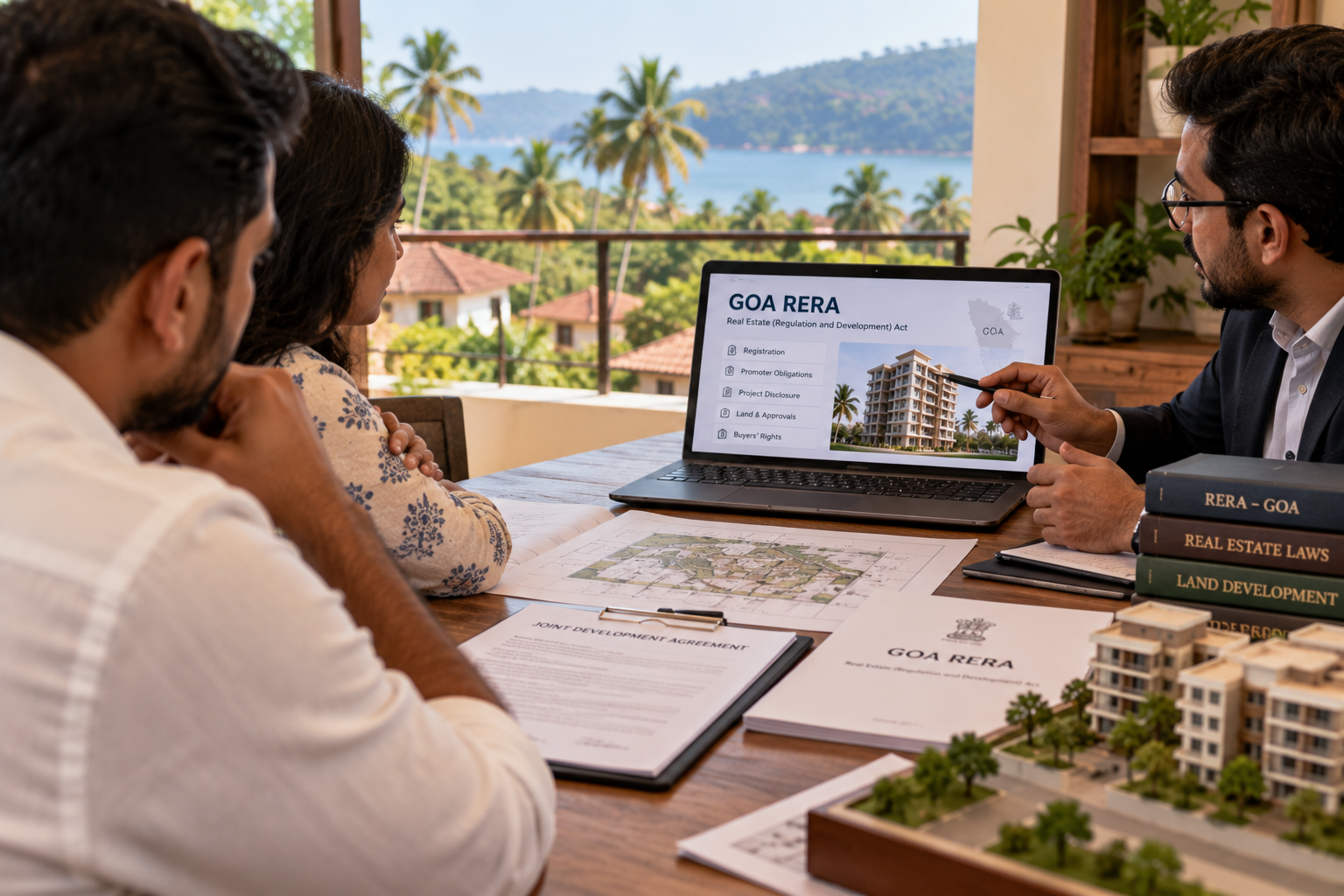
Goa RERA & Joint Development: Landowners May Be Treated as Promoters
A Goa landowner entering a Joint Development Agreement may think of the roles very simply:
The landowner contributes the land.
The developer builds and sells the project.
Therefore, the developer handles RERA.
That assumption can be dangerous.
Under the Real Estate (Regulation and Development) Act, 2016 and Goa RERA’s published guidance on projects using the Joint Development Agreement route, a landowner can fall within the promoter framework alongside the developer.
That can matter because the word promoter under RERA is associated with statutory responsibilities connected to a registered real-estate project.
Landowners should therefore understand the proposed structure before signing a JDA rather than assuming that providing land keeps them completely outside the project’s regulatory responsibilities.
If you are considering a joint-development proposal for land in Goa, Builders & Brokers can help you organise the commercial structure, understand the questions that should be raised and coordinate appropriate RERA, legal and professional review before you commit the property.
Quick Answer: Can a Goa Landowner Be Treated as a Promoter Under RERA?
Yes, in relevant joint-development structures.
Goa RERA has specifically addressed projects registered through the Joint Development Agreement route and has stated that the landowner may be treated as a promoter along with the development-side promoter.
Where different parties develop the project and sell the apartments or plots, the RERA framework can also create joint responsibility for applicable promoter functions.
However, the position of a particular landowner depends on the actual project, agreement, activities undertaken and applicability of RERA.
Do not assume that every landowner in every property arrangement automatically has identical obligations.
Why the Word “Landowner” Is Not Enough
Commercial discussions often use labels such as:
- Landowner
- Developer
- Builder
- Investor
- Development partner
- Area-share partner
- Revenue-share partner
Those labels may describe the commercial relationship, but they do not necessarily decide the regulatory position.
The actual arrangement matters.
For example, a landowner may contribute land while another party:
- Designs the project
- Funds development
- Obtains project approvals
- Constructs villas or apartments
- Markets units
- Deals with purchasers
The agreement may also give the landowner a share of developed area or revenue.
That is why the JDA should be reviewed as an entire structure rather than assuming that the party physically constructing the project is the only possible promoter.
Where discussions are still at an earlier stage, landowners should also clarify the development structure before signing an MOU, including the proposed commercial model, responsibilities, preliminary terms and what remains subject to further professional review.
Understand Whether RERA Applies to the Project First
Before asking who the promoter is, owners should first establish whether the proposed project falls within the applicable RERA registration framework.
RERA contains exemptions for certain categories of projects, including projects below specified thresholds and certain renovation or redevelopment situations that do not involve new marketing, advertising, sale or allotment.
The exact project needs to be checked against current requirements.
Landowners should therefore avoid two opposite assumptions:
“Every development is automatically RERA registered.”
and
“Because I only own the land, RERA has nothing to do with me.”
Both can oversimplify the situation.
Joint Development Can Create More Than One Promoter
RERA specifically contemplates situations where one person develops a project while another sells apartments or plots.
In such circumstances, the parties may both fall within the promoter framework and may share responsibility for the applicable obligations.
This is important for landowners because a JDA can sometimes divide activities between parties.
The developer might control construction while the landowner participates in the project through land contribution, area entitlement, revenue entitlement or another agreed structure.
The legal and regulatory effect should be professionally reviewed before the structure is finalised.
Builders & Brokers can help landowners identify these questions early rather than waiting until project registration or buyer transactions begin.
Revenue Share and Area Share Need Proper Review
Joint-development projects may be structured in different commercial ways.
Two familiar concepts are:
Revenue Share
The landowner receives an agreed share connected to project revenue.
Area Share
The landowner receives an agreed portion of the developed area or units.
These commercial descriptions do not by themselves answer the landowner’s RERA position.
Goa RERA’s published FAQ guidance has specifically discussed joint development on revenue-share and area-share bases and refers to landowners or other parties benefiting from project sales as co-promoters in the relevant context.
Owners should therefore understand both the commercial benefit and the associated responsibility.
Promoter Responsibilities Go Beyond Project Registration
Being treated as a promoter is not simply about having a name displayed on a registration page.
The RERA Act contains promoter responsibilities concerning areas such as:
- Project registration
- Information and disclosures
- Accuracy of advertising
- Agreements with allottees
- Adherence to sanctioned plans
- Project accounts and financial requirements
- Project completion commitments
- Transfer of title and documents
- Other obligations toward allottees
Which responsibilities apply to each party should be reviewed in the context of the project and agreement.
A JDA should not simply say “all RERA responsibility belongs to the developer” without qualified advice on whether that allocation is legally effective.
Check How the Landowner Is Shown in the RERA Application
Goa RERA has specifically issued guidance about correctly filing landowner details in project-registration applications under the JDA route.
That means landowners should understand how they will appear in the project documentation.
Before registration, ask:
- How will the landowner be identified?
- Who is shown as promoter?
- Who is the authorised person?
- What JDA information is being submitted?
- What declarations involve the owner?
- What project information will become public?
- Who is responsible for future portal updates?
The owner should not sign declarations or allow details to be filed without understanding their purpose.
Review Who Will Sell or Receive Project Proceeds
Another important issue is the relationship with purchasers.
Ask:
- Who markets the villas or apartments?
- Who signs agreements with buyers?
- Who receives buyer payments?
- Does the landowner sell their allocated units separately?
- Does the developer sell the entire inventory?
- How is the owner’s commercial share received?
These questions may affect both the commercial and regulatory analysis.
Landowners should not treat them merely as accounting details.
Do Not Assume the JDA Can Remove Statutory Responsibility
A JDA can allocate responsibilities between the landowner and developer.
For example, the parties may agree who handles:
- Construction
- Applications
- Sales
- Customer communication
- Accounting
- Professional appointments
- Project management
But a private agreement should not be assumed to override statutory responsibilities that may apply under RERA.
This is particularly important where both parties may be treated as promoters.
The agreement should therefore be reviewed not only for what the parties want commercially, but also for whether those responsibilities align with applicable law.
Ask What Happens if the Developer Defaults
Landowners should also consider the regulatory implications of project problems.
Questions may arise if the developer:
- Stops construction
- Misses project milestones
- Has funding difficulties
- Makes unauthorised changes
- Fails to update project information
- Creates disputes with buyers
- Does not complete promised obligations
If the landowner is also treated as a promoter, saying “the developer was supposed to handle that” may not answer every regulatory or allottee issue.
This is why developer selection, agreement drafting and project monitoring matter. Before entering the partnership, owners should also understand what landowners should plan for if a development project is delayed, including milestone reporting, prolonged inactivity, extensions and the process for dealing with repeated delays.
This is why developer selection, agreement drafting and project monitoring matter.
Keep RERA Review Separate From General Property Advice
Builders & Brokers can help landowners understand the proposed property-development direction, compare partnership structures and organise the commercial questions that should be answered.
But determining the exact legal obligations of a particular JDA requires qualified legal and RERA advice.
Depending on the project, input may also be required from:
- Chartered accountants
- Architects
- Engineers
- RERA professionals
- Tax advisors
- Other specialists
The earlier these professionals understand the proposed structure, the easier it is to identify problems before the landowner signs.
Final Recommendation
Goa landowners should not enter a Joint Development Agreement assuming that RERA belongs entirely to the developer.
In relevant JDA projects, the landowner may also fall within the promoter framework and may share applicable responsibilities.
Before signing, understand:
- Whether RERA applies to the proposed project
- How the landowner will be identified
- Who will market and sell units
- Who receives project proceeds
- How responsibilities are allocated
- What declarations will be filed
- What happens if the developer fails to perform
Builders & Brokers helps Goa landowners evaluate development opportunities, understand proposed partnership structures and coordinate the professional questions that should be answered before committing land. Speak to Builders & Brokers before signing a JDA so the commercial opportunity and the responsibilities attached to it are considered together.
FAQs
Is every Goa landowner automatically a RERA promoter?
No. The position depends on the project, RERA applicability and the actual development arrangement. However, Goa RERA specifically recognises landowners as promoters in relevant JDA structures.
Can both the landowner and developer be promoters?
Yes. RERA contemplates situations where different parties develop and sell the project and can treat both as promoters with applicable joint responsibilities.
Does an area-share or revenue-share JDA affect the RERA position?
It can be relevant. Goa RERA has specifically addressed revenue-share and area-share joint-development structures, so the arrangement should be professionally reviewed.
Can a JDA state that only the developer is responsible for RERA?
The parties can allocate commercial responsibilities contractually, but they should not assume a private clause automatically removes statutory responsibilities imposed by applicable law.
Can Builders & Brokers determine whether I am legally a promoter?
Builders & Brokers can help structure the landowner and development discussion and coordinate appropriate professional review. A project-specific legal or RERA determination should come from qualified professionals.


