
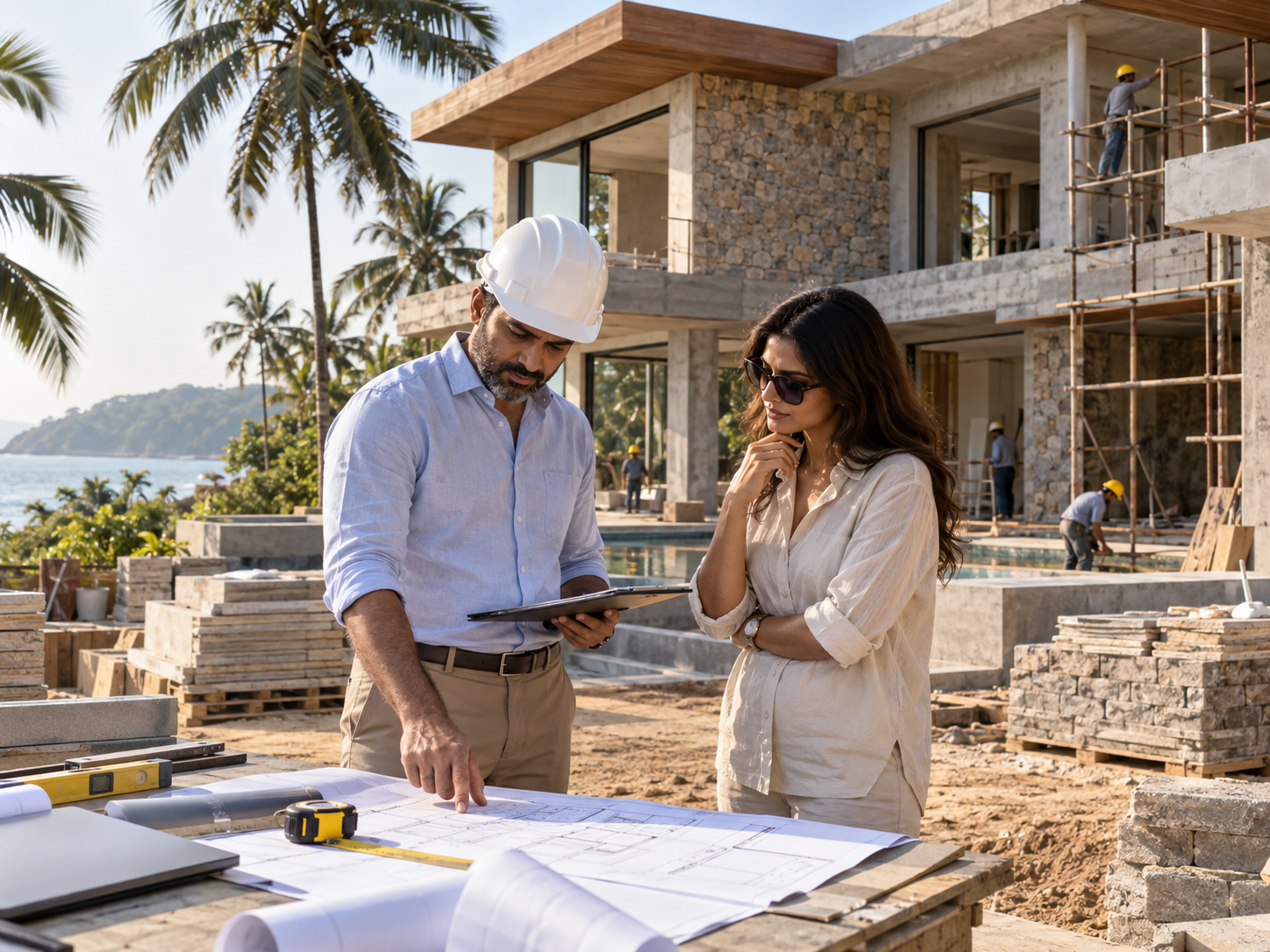
Independent Project Monitor for Goa Villa Projects: Does an Owner Need One?
A Goa landowner entering a villa-development arrangement may assume that once a developer, architect and contractor are appointed, the owner no longer needs anyone independently following the project.
That can leave the owner dependent entirely on information coming from the development side.
For some projects, especially where the landowner is not regularly present on-site, appointing an independent project monitor or owner-side representative can create an additional layer of visibility.
The purpose is not to duplicate the architect, engineer or contractor. It is to help the landowner understand what is happening, whether agreed milestones are being reported clearly, what changes are being proposed and which questions need to be escalated to qualified professionals.
If you are a Goa landowner considering a villa-development partnership, Builders & Brokers can help you define the information, reporting and owner-side oversight you may want before the project moves into execution.
Quick Answer: What Does an Independent Project Monitor Do?
An independent project monitor represents the landowner’s information and oversight interests rather than the developer’s execution interests.
Depending on the agreed scope, the role may involve:
- Periodic site visits
- Progress reporting
- Milestone tracking
- Recording major changes
- Following up on pending decisions
- Organising photographs and site records
- Coordinating questions for architects or engineers
- Alerting the owner when agreed progress appears to differ from what is being reported
The monitor should not make technical certifications, legal conclusions or engineering decisions outside their professional qualifications.
Why Developer-Led Reporting May Not Be Enough
A developer naturally manages the project from the development side.
Reports may focus on:
- Work completed
- Immediate site priorities
- Contractor activity
- Upcoming decisions
- Commercial requirements
The landowner may have different concerns.
For example:
- Is the project following the agreed development direction?
- Have important site features been altered?
- Has the layout changed?
- Are delays appearing?
- Is additional land being used temporarily?
- Are new costs or obligations being discussed?
- Are decisions being made that require owner approval?
An owner-side monitor can help keep those questions visible.
Independent Does Not Mean Adversarial
Appointing someone independently should not be treated as a sign that the landowner distrusts the developer.
A well-defined monitoring role can actually improve communication.
The monitor can help create a structured flow:
Developer → Progress Information → Independent Record → Landowner Review
Instead of receiving scattered phone calls, photographs and WhatsApp updates, the owner receives information in a consistent format.
This can be especially valuable when several family members are involved.
Define the Role Before the Project Starts
“Keep an eye on the project” is not a useful scope.
The landowner should define what monitoring actually means.
Possible responsibilities may include:
- Monthly or fortnightly progress updates
- Photographic records
- Tracking agreed milestones
- Maintaining a decision log
- Recording major variations
- Following unresolved owner queries
- Monitoring use of retained areas
- Reporting obvious site-access issues
- Coordinating progress meetings
- Maintaining copies of approved project information
The scope should also clearly state what the monitor cannot do.
For example, a general project monitor should not be treated automatically as the:
- Structural engineer
- Architect
- Quantity surveyor
- Legal advisor
- Safety officer
- Approval consultant
- Quality-certifying professional
Those responsibilities require the appropriate qualified professionals.
Track Milestones, Not Just Activity
A busy site does not automatically mean the project is progressing according to plan.
Landowners should identify agreed milestones that can be followed.
These might relate broadly to:
- Site mobilisation
- Survey completion
- Design stages
- Approval stages
- Major construction stages
- Infrastructure work
- Landscape stages
- Completion-related documentation
The exact milestones will vary by project.
The monitor’s role is not necessarily to certify that each stage meets technical standards. It may simply be to confirm that the stage has been reported as reached, gather evidence and flag questions for professional review.
Create a Simple Progress Report
Landowners do not need an enormous report every week.
A useful report might include:
| Monitoring Item | Update |
| Current project stage | What is underway |
| Work since previous report | Main visible progress |
| Upcoming milestone | Next expected stage |
| Delays | Any reported slippage |
| Design changes | Changes raised since last report |
| Owner decisions required | Items awaiting response |
| Site photographs | Dated images |
| Professional query | Issue requiring architect/engineer/legal input |
Consistency is often more valuable than excessive detail.
Builders & Brokers can help landowners define the type of reporting they want before discussions with the development team become fragmented.
Record Changes as They Happen
Villa projects often evolve.
Changes may involve:
- Villa positioning
- Internal access
- Landscape areas
- Retaining structures
- Common facilities
- Materials
- Services
- Existing structures
- Trees or site features
- Construction sequence
Not every change is a problem.
The problem occurs when the landowner later discovers that an important decision was made without understanding when, why or by whom it was approved.
A change log can record:
- What changed
- Why it changed
- Who proposed it
- Which professional reviewed it
- Whether owner approval was required
- When the decision was made
This creates a clearer project history.
Monitoring Can Matter More for NRI and Absentee Landowners
Many Goa property owners live outside the state or outside India.
They may receive:
- Selected site photographs
- Short video calls
- Informal progress messages
- Updates through relatives
That can make it difficult to build a complete picture of the project.
An owner-side monitor can provide regular structured observations from the site and help the owner decide when a particular issue needs direct attention from an architect, engineer, lawyer or other professional.
The monitor should still avoid making technical conclusions outside the agreed scope.
Watch the Boundary Between Monitoring and Management
There is an important difference between monitoring a project and managing it.
A monitor may observe and report.
A project manager may have broader authority to:
- Coordinate contractors
- Manage programme schedules
- Review commercial information
- Issue instructions within an agreed authority
- Coordinate consultants
- Manage project documentation
Landowners should know which role they actually need. It is also useful to understand the roles in a Goa development project so the responsibilities of the architect, property consultant, developer and any independent project monitor are not confused or unnecessarily duplicated.
A smaller villa development may require only periodic independent reporting. A larger or more complicated development may justify a more formal project-management structure.
Agree on Access to Information
An independent monitor cannot provide useful oversight if they receive no information.
Before appointment, clarify whether the monitor may access relevant:
- Site meetings
- Progress schedules
- Approved plans
- Change records
- Site photographs
- Consultant reports
- Milestone updates
- Project correspondence relevant to their scope
Confidentiality and document-sharing rules should also be established.
The developer should understand the monitor’s role so normal information requests do not become a source of conflict.
Decide Who the Monitor Reports To
Where several family members own the land, this can become surprisingly important.
Should the monitor report to:
- One nominated owner?
- All co-owners?
- A family representative?
- A landowner committee?
- The owner’s professional advisor?
There should be one clear communication structure.
Otherwise, different family members may issue conflicting instructions or interpret progress differently.
What Should Trigger Escalation?
The monitor should know when an observation must be referred to someone else.
Examples might include:
- Significant deviation from an agreed plan
- Long unexplained periods of inactivity
- Proposed use of land outside the agreed project area
- Major design change
- Potential structural concern
- Disagreement over owner approval
- New commercial demand
- Possible regulatory issue
- Damage to retained property
The monitor should report the issue—not pretend to provide a legal, structural or regulatory determination.
Is an Independent Project Monitor Necessary for Every Villa Project?
No.
Some landowners may remain actively involved, live close to the property and already have trusted independent professionals reporting to them.
Others may have a developer with a strong, transparent reporting system that gives the owner adequate visibility.
The question is not:
“Must every project have a monitor?”
The better question is:
“Who is independently keeping the landowner informed?”
If the answer is nobody, the owner should consider whether an oversight gap exists.
Final Recommendation
When a developer leads a Goa villa project, the landowner should still have a clear way to understand what is happening on the property.
An independent project monitor can help by tracking milestones, recording changes, maintaining site updates and directing important questions to the right professionals.
The role should be clearly defined and should not duplicate or replace architects, engineers, legal advisors or other qualified specialists.
Builders & Brokers helps Goa landowners structure development discussions, owner-side reporting expectations and project-consultation requirements. If a developer will be managing the villa project, speak to Builders & Brokers about how you will maintain independent visibility before execution begins.
FAQs
What is an independent project monitor for a Goa villa project?
It is an owner-side role focused on observing progress, organising reports, tracking agreed milestones and raising issues that require further professional review.
Is a project monitor the same as an architect?
No. An architect has a defined professional design role. A project monitor may focus primarily on reporting and owner visibility unless they separately hold relevant qualifications and responsibilities.
Can the developer provide all project updates instead?
Yes, and some developers may have strong reporting systems. The landowner should decide whether those updates provide enough independent visibility for the project.
Is project monitoring useful for NRI Goa landowners?
It can be particularly useful where the owner cannot visit the property regularly and wants structured independent site updates.
Can Builders & Brokers act as the project’s architect or engineer?
Builders & Brokers can support landowner development discussions, project coordination and advisory planning. Architectural, engineering and other regulated technical work should be performed by appropriately qualified professionals.


