
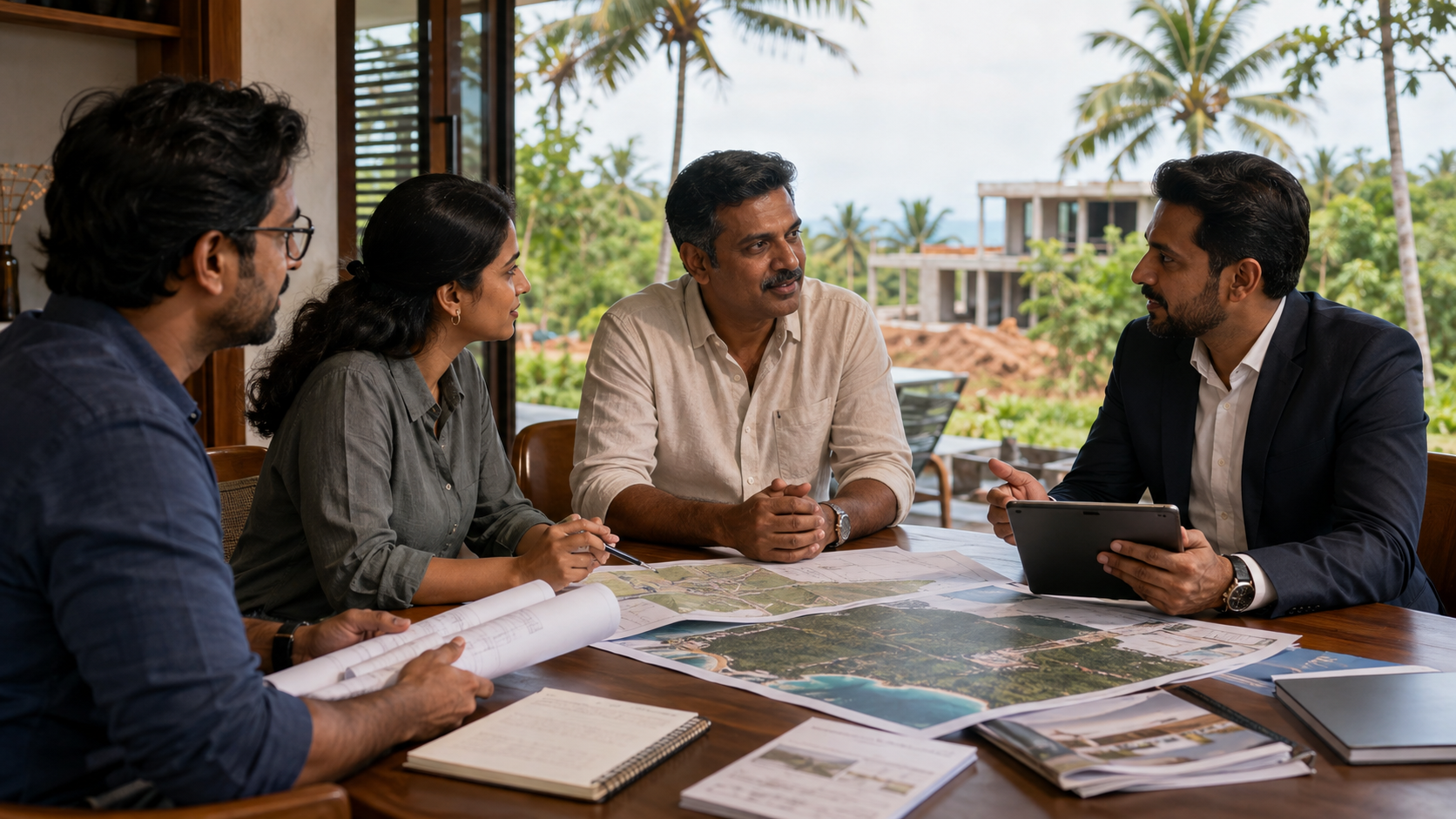
Architect, Property Consultant or Developer: Who Should Goa Owners Approach?
A Goa landowner considering a sale, private villa, redevelopment or larger project may receive different advice about whom to contact first.
One person may suggest speaking to an architect. Another may recommend approaching a developer. A family member may say the property should first be valued or marketed. The owner can quickly end up having several conversations without knowing which professional is meant to answer which question.
There is no single correct sequence for every property. The right starting point depends on what the landowner already knows and which decision still needs to be made.
If you own land or an older property in Goa and are unsure whether to approach an architect, property consultant or development partner first, Builders & Brokers can help you clarify the property direction and organise the next professional conversation.
Quick Answer: Who Should a Landowner Approach First?
A property consultant may be the best first contact when the owner is still comparing sale, hold, villa, redevelopment or partnership options.
An architect may be the right starting point when the owner has already decided to explore a defined design or construction idea.
A development partner should usually be approached after the owner understands the property objective, basic constraints, expectations and level of control they are willing to share.
The sequence may change depending on the property and professional advice required.
Start With the Decision, Not the Professional
Before arranging meetings, the landowner should identify the immediate question.
Is the owner trying to understand:
- Whether to sell or develop?
- What type of buyer may value the property?
- Whether a private villa idea is worth exploring?
- What kind of design may suit the site?
- Whether a developer partnership should be considered?
- How the property should be positioned?
- What information should be reviewed first?
When the question is unclear, professionals may give answers to different problems. An architect may start discussing layout. A developer may discuss commercial possibilities. A broker may focus on selling price. None of these conversations will fully help if the owner has not identified the decision.
When to Approach a Property Consultant First
A property consultant can be useful at the early decision stage, especially when the landowner has not committed to one direction.
The consultant may help the owner:
- Understand the property’s likely market position
- Compare direct sale with other routes
- Identify possible buyer categories
- Organise the owner’s objectives
- Review whether a development conversation is commercially relevant
- Prepare information for other professionals
- Coordinate valuation, legal, planning or architectural discussions
- Avoid presenting the property with unsupported claims
Builders & Brokers works in this advisory stage by helping Goa landowners understand whether the property should first be positioned for sale, buyer matching, villa consultation, redevelopment discussion or development opportunity review.
A property consultant does not replace architects, engineers, legal professionals or planners. The role is to help the owner understand which conversation should happen next.
When to Approach an Architect First
An architect may be the right early contact when the landowner already has a clear intention to explore a private home, villa, renovation, adaptive reuse or defined development concept.
The architect may help with:
- Understanding the owner’s space requirements
- Reviewing the site from a design perspective
- Preparing an early concept
- Considering the relationship between the building and the land
- Identifying technical information needed
- Coordinating with engineers and other design professionals
- Explaining which ideas need further planning review
However, an architect should not be expected to decide the market value of the property, find the correct buyer, negotiate a land partnership or guarantee project approval.
If the owner has not yet decided whether development is the right route, starting with design work may be premature.
When to Approach a Development Partner
A development partner may enter the conversation when the landowner is considering a structured project or partnership rather than handling the entire process independently.
The partner may discuss areas such as:
- Project direction
- Funding responsibility
- Development coordination
- Professional-team involvement
- Construction and execution approach
- Sales or marketing responsibility
- Commercial sharing
- Project timeline
- Risk allocation
Before approaching or accepting interest from a development partner, the landowner should understand their own goals.
Does the owner want to sell completely? Retain a stake? Receive developed area? Participate in decisions? Keep part of the land? Avoid long-term involvement?
Without this clarity, the developer’s proposal may begin shaping the owner’s decision before the owner has properly evaluated the alternatives.
Why Approaching a Developer First Can Be Risky
A developer may present an attractive project idea quickly. That idea may be worth exploring, but it will usually reflect the developer’s business model and priorities.
The owner should not assume that the first proposal represents the property’s only or best direction.
Approaching a developer too early may result in:
- Agreeing to a project scale before alternatives are compared
- Sharing documents without a clear process
- Discussing exclusivity prematurely
- Focusing on projected upside without reviewing risk
- Ignoring a direct-sale option
- Underestimating the owner’s future responsibilities
- Allowing commercial terms to shape the project too early
This does not mean developer discussions should be avoided. It means they should happen after the landowner is prepared to evaluate them.
Where Legal and Planning Professionals Fit
Some property decisions require legal, title, zoning, planning, environmental or technical review before the owner can proceed confidently.
These professionals should be involved when their expertise becomes relevant. A property consultant, architect or developer should not make final legal or regulatory conclusions outside their qualifications.
For example, an attractive architectural concept does not confirm permission. Developer interest does not confirm title clarity. A strong valuation does not prove that a particular project can proceed.
Landowners should be cautious of anyone who claims to answer every legal, technical, design and commercial question alone.
A Practical Professional Sequence
The following sequence may help owners understand the general flow:
| Landowner Situation | Possible First Conversation | Likely Next Step |
| Unsure whether to sell or develop | Property consultant | Valuation, market review or professional coordination |
| Wants to explore a private villa | Architect | Planning, engineering and cost review |
| Has received developer interest | Property consultant or legal advisor | Proposal, title and commercial review |
| Wants a formal valuation | Qualified valuer | Sale, family or negotiation decision |
| Has a defined project idea | Architect or specialist consultant | Feasibility and professional review |
| Considering a partnership | Property and legal advisors | Developer evaluation and structured discussions |
This is not a fixed rule. The sequence should match the property and the owner’s decision stage.
Prepare Before the First Meeting
Whatever professional the landowner approaches, prepare basic information first:
- Property location and survey details
- Available ownership papers
- Existing structures
- Current use
- Family ownership or decision-makers
- Reason for exploring the property
- Preferred outcome
- Expected timeline
- Known concerns
- Questions requiring answers
The owner does not need every document or answer on day one. But organised information improves the quality of the discussion.
Common Sequencing Mistakes
Goa landowners should avoid:
- Asking an architect to determine the property’s selling price
- Asking a broker to confirm technical feasibility
- Asking a developer to provide independent legal conclusions
- Paying for detailed design before agreeing on the property direction
- Entering exclusivity before understanding the proposal
- Approaching multiple professionals without one clear objective
- Assuming one professional can replace all others
- Treating an informal concept as a confirmed project
The right professional can only help effectively when the question falls within their role.
Final Recommendation
A Goa landowner should not choose the first professional based only on who is easiest to contact.
Start by identifying the decision.
If the owner is still comparing sale, development and partnership directions, a property consultant may be the appropriate starting point. If the project intention is already clear, an architect may help develop the concept. If a partnership is being considered, a development partner should be approached only after the owner understands the proposal, responsibilities and professional checks required.
Builders & Brokers helps Goa landowners clarify property direction, prepare for professional discussions and coordinate the next advisory step. Speak to Builders & Brokers before approaching multiple parties so each professional is asked the right question at the right stage.
FAQs
Should a Goa landowner speak to an architect before a property consultant?
It depends on the decision. If the owner already wants to explore a defined villa or building concept, an architect may be appropriate. If the owner is still comparing sale and development options, a property consultant may be the better first contact.
Can a property consultant confirm that a villa project is technically possible?
Not alone. Technical, planning, architectural and legal questions should be reviewed by appropriately qualified professionals.
When should a development partner be approached?
A development partner should generally be approached after the owner has clarified their goals, expectations, decision rights and willingness to enter a longer-term arrangement.
Is a developer the same as a property consultant?
No. A developer may propose or execute a project, while a property consultant helps the owner understand market positioning, options and the right next professional conversation.
Can Builders & Brokers coordinate professional discussions?
Builders & Brokers can help landowners clarify their property direction and coordinate discussions with appropriate professionals. Formal legal, technical, architectural and valuation work should be handled by suitably qualified experts.


