
Index form of lands goa | The Essential Guide to Property Records
Investing in the Goa real estate market is currently a “genuine growth story,” attracting interest from global investors and local homebuyers alike. However, the state’s unique history—transitioning from Portuguese rule to the Indian Union—has left a complex trail of documentation that can be a minefield for the uninitiated. One of the most critical documents for any real estate transaction is the index form of lands goa. Whether you are conducting an ancestral land search Goa DSLR or simply verifying a modern apartment title, this document is the backbone of your legal due diligence.
At Builders & Brokers, we know that in 2026, “average is the new bad” when it comes to property documentation. Overlooking a single historical entry can lead to decades of litigation. That is why we offer comprehensive Index of Land extract services Goa, providing end-to-end support and handling all the “nitty-gritty” paperwork so you don’t have to.
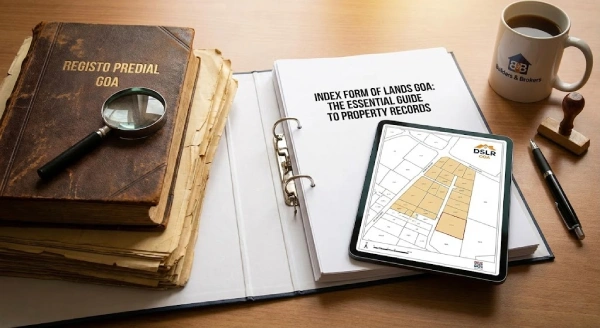
Index form of lands goa what is it?
If you are asking, “index form of lands goa what is it?“, you are not alone. Simply put, the index of land form goa is an official government register maintained by the Directorate of Settlement and Land Records (DSLR). It serves as a chronological record of a specific property, detailing the chain of ownership, nature of the land, and any historical encumbrances or changes in title.
While many buyers are familiar with Form I & XIV (the modern Record of Rights), the Index Form provides a deeper historical context. It is essentially a “Property Register Extract” that tracks how a piece of land moved from one owner to another, often spanning back to the Portuguese era. For anyone involved in property title verification services Goa, this is the primary source of truth for confirming that a seller has the absolute legal right to transfer the property.
Why You Need a Certified Copy of Index of Land Panjim
In the modern Goan market, having a “clean title” is mandatory for everything from bank loan approvals to Goa RERA project registration. Obtaining a certified copy of Index of Land Panjim is vital for several reasons:
- Legal Due Diligence: It helps identify missing heirs or old Portuguese-era claims that might not be reflected on the current Form I & XIV.
- Bank Loans: Most financial institutions will not sanction a home loan without a 30-year title search report, which relies heavily on these index records.
- RERA Compliance: Under Section 4 of the RERA Act, developers must provide clear disclosures regarding land title. The Index Form provides the necessary evidence for these disclosures.
- Dispute Prevention: By seeing the historical “Index,” you can spot potential boundary disputes or “inscriptions” that might affect your future development rights.
Land Record Reconciliation Services Goa: Bridging the Old and New
One of the greatest challenges in Goa is the Land record reconciliation services Goa. This involves matching old Portuguese records, such as the Matriz certificate, with modern survey numbers. Often, a property might be described in a 1940s Portuguese deed by an “Artigo” number, while the modern DSLR map uses a completely different survey number.
The index form of lands goa is the bridge between these two systems. It allows a Goa property register extract consultant to trace the “DNA” of the land through its various mutations and sub-divisions. This reconciliation is essential for obtaining a Form III (Correspondence Certificate), which proves the old and new records refer to the exact same plot of land.
Remote Land Record Retrieval Goa for NRIs and Outstation Owners
The Goa real estate market is a major hub for NRIs and professionals from cities like Mumbai and Bangalore. However, government offices in Panjim still require physical presence or authorized representation for record retrieval.
Builders & Brokers specializes in remote land record retrieval Goa. We act as your local feet on the ground, navigating the DSLR office in Panjim to find even the most obscure ancestral records. Our services include:
- Physical Record Searching: We manually search the DSLR archives for old index entries.
- Liaising with Authorities: We handle the application process for certified copies.
- Portuguese Translation: If your index records contain archaic Portuguese legal terms, we provide certified translation to ensure they are accepted by modern courts and banks.
- Mutation and Paperwork: Once we find the records, we handle the subsequent property mutation goa to ensure your name is correctly updated in the government files.
Frequently Asked Questions (FAQ)
Form I & XIV is a record of current occupancy and land nature. The index form of lands goa is a historical register that tracks the chain of title transfers and mutations over several decades. You need both for a comprehensive title search.
While the Goa government is moving toward digital registration and mandatory e-stamping (as of April 2026), many older historical index records still require a physical search at the DSLR office in Panjim.
An Artigo number is the identification number used in the Portuguese-era registration system. It is often necessary to find this number to reconcile old records with modern survey sub-divisions.
Typically, the process at the DSLR takes between 30 to 90 days, depending on the clarity of the property’s history and whether field verification is required.
Goan land laws involve a mix of the Uniform Civil Code and Portuguese-era regulations that differ from the rest of India. A professional Goa property register extract consultant ensures you don’t miss hidden legal hurdles that could result in your registration being refused or penalized.
Conclusion: Securing Your Piece of Paradise
The Goa property market in 2026 is safe and offers “sure-shot long-term appreciation,” but only if your foundation is built on solid paperwork. The index form of lands goa is more than just a piece of paper; it is the legal proof of your property’s heritage and your future security.


