
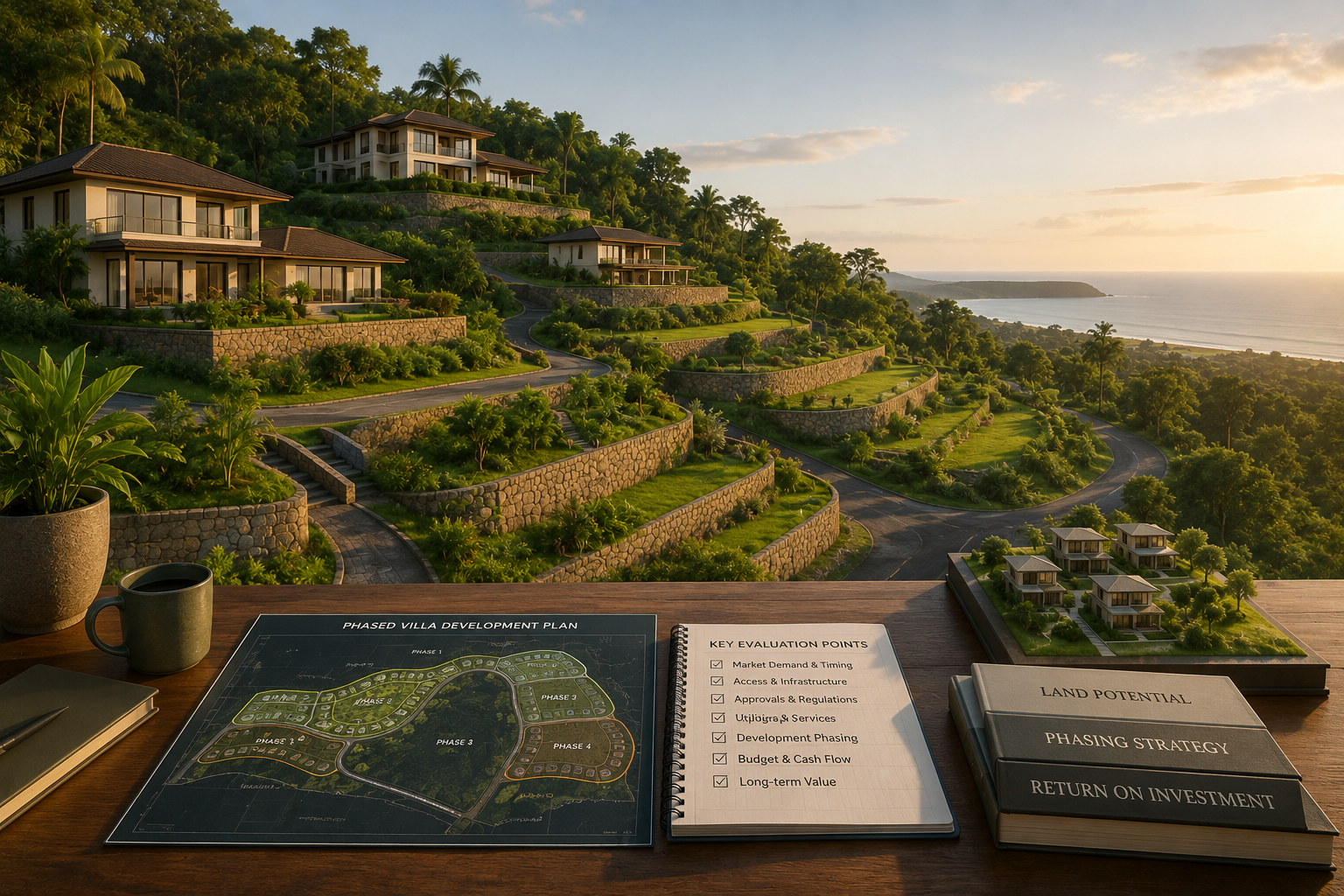
Phased Villa Development in South Goa: What Landowners Should Evaluate
Owners of large land parcels in South Goa may be approached with an ambitious proposal: use the entire property for a villa project, complete the development in one plan and maximise the opportunity from the beginning.
That may suit some properties. But committing the full parcel immediately can also reduce the owner’s flexibility, increase exposure and make it harder to change direction later.
Phased villa development offers another possibility. Instead of placing the whole property into one project from the start, the owner may explore whether a clearly defined portion can be considered first while the remaining land is retained for future use.
This is not automatically the better route. Phasing requires careful planning, professional review and a clear understanding of how the first phase may affect everything that follows.
If you own a large land parcel in South Goa and are considering a villa project, Builders & Brokers can help you compare full-parcel commitment with phased-development possibilities before you enter serious discussions with consultants or development partners.
Quick Answer: Why Consider Phased Villa Development?
Phased development may help a landowner retain part of the property, limit the first-stage commitment, observe project progress and preserve options for later.
However, owners must first evaluate phase boundaries, access, shared infrastructure, professional costs, family goals, future land use and the effect of the first phase on the remaining parcel.
Phasing does not remove the need for applicable planning, legal, technical and regulatory review.
Begin With the Owner’s Long-Term Goal
Before discussing villas or layouts, the owner should decide what they want from the land over the long term.
The objective may be to:
- Generate value from only part of the property
- Retain land for family use
- Preserve a future residence
- Avoid committing the whole family asset
- Test a development concept in a smaller first stage
- Keep a portion available for later sale
- Build gradually rather than manage one large project
- Leave flexibility for future generations
A phased approach only makes sense when it supports a defined owner goal.
Without that clarity, the land may be divided into stages on paper without creating any real strategic advantage.
Decide What the First Phase Is Meant to Prove
The first phase should have a clear purpose. It should not simply be the easiest part of the land to start using.
The owner may want the first phase to test:
- Market response to the villa concept
- The development partner’s performance
- The owner’s comfort with the process
- Infrastructure requirements
- Construction and coordination realities
- Buyer expectations
- The commercial understanding between parties
- Whether further development still suits the family
The first phase should create useful information before a second commitment is made.
That does not guarantee that later phases will proceed. The owner should retain the ability to review the next stage based on actual experience.
Define the Phase Boundary Carefully
A phase should have a clear and professionally reviewed boundary.
Poorly planned boundaries may leave the retained land with:
- Difficult access
- Irregular usable space
- Dependence on the first phase
- Reduced privacy
- Infrastructure crossing through future areas
- Unclear maintenance responsibility
- Limited future positioning
- Disputes over common areas
The most convenient first-phase boundary may not be the best long-term division.
Owners should understand how roads, open spaces, utilities, drainage routes, shared facilities and project entrances may affect both the developed and retained portions.
Protect Access to the Remaining Land
Access is one of the most important issues in phased planning.
If the first phase controls the main entrance or road connection, the retained land may become dependent on the completed project. This can affect future use, sale discussions and family access.
Before committing any portion, owners should ask:
- How will the retained land be reached?
- Will the access be independent or shared?
- Who will maintain a shared road?
- Can future construction traffic use the same approach?
- Will gates or security arrangements restrict movement?
- Are access rights being recorded appropriately?
- Could the first phase reduce the future parcel’s road presence?
These questions should be reviewed professionally before the phase is finalised.
Plan Shared Infrastructure Before Work Begins
A phased villa project may require infrastructure that serves more than one stage.
This could include:
- Internal roads
- Water arrangements
- Drainage
- Power connections
- Wastewater systems
- Site lighting
- Security or gate infrastructure
- Landscape areas
- Common utility corridors
Owners should understand whether the first phase will include infrastructure sized only for that stage or whether it will anticipate later development.
Oversizing infrastructure too early may increase initial costs. Undersizing it may create expensive changes later.
This is why phased development needs coordination between the owner, architect, technical professionals and relevant advisors.
Do Not Assume Phasing Reduces Approval Requirements
Dividing a project into stages should not be used to avoid professional or regulatory review.
The required process depends on the property, the project and the applicable framework. Each proposed phase may need to be considered within the larger land and development context.
Owners should avoid accepting claims such as:
- “We can start with a few villas without checking the whole plan.”
- “The second phase can be regularised later.”
- “A smaller phase will not need proper review.”
- “Future approvals are guaranteed once Phase One begins.”
Only qualified professionals and relevant authorities can advise on the requirements applicable to the property.
Compare Full Commitment With Phased Commitment
| Decision Area | Entire Parcel | Phased Approach |
| Owner flexibility | Lower after full commitment | May preserve later options |
| Initial project scale | Larger | More limited first stage |
| Early infrastructure | Planned for full project | Must balance current and future needs |
| Retained family land | Usually limited | May be protected if structured properly |
| Partner exposure | Whole project relationship | Performance may be observed in stages |
| Future decision | Often shaped from the start | Can be reviewed before the next phase |
| Complexity | One larger structure | Requires clear boundaries between stages |
Neither route is automatically better. The right choice depends on owner priorities, property conditions and professional review.
Clarify What Triggers the Next Phase
The landowner should not assume that Phase Two begins automatically.
Possible trigger points may include:
- Completion of agreed Phase One milestones
- Owner satisfaction with performance
- Required professional reviews
- Market response
- Funding readiness
- Family approval
- Resolution of infrastructure questions
- A fresh commercial agreement
The trigger should be clear before the first phase begins.
Otherwise, the owner may feel pressured to release more land simply because work has already started.
Consider Family and Succession Plans
Large South Goa land parcels are often family assets. Some relatives may support development, while others may want to preserve part of the land.
Phasing can help separate immediate opportunity from long-term family decisions, but only if the ownership and expectations are clear.
The family should discuss:
- Which portion may be considered
- Which portion must remain untouched
- Who can approve later phases
- Whether retained land has a separate family purpose
- How future sale or inheritance decisions may be affected
- Whether all necessary decision-makers understand the proposal
These discussions should happen before outside parties are given confidence that the entire parcel will eventually be available.
Builders & Brokers’ Role
Builders & Brokers can help South Goa landowners compare full-parcel development with phased-development discussions, organise the owner’s objectives and prepare for conversations with architects, valuers, legal professionals and potential development partners.
The role is advisory. Formal planning, design, legal, engineering and approval work should be carried out by appropriately qualified professionals.
Final Recommendation
Phased villa development can help South Goa landowners avoid committing an entire parcel before they understand the project, partner and long-term effect on the remaining land.
But phasing must be more than drawing a line across a site.
Owners should evaluate the first phase’s purpose, future access, infrastructure, retained-land usability, family goals, professional requirements and conditions for releasing the next stage.
Builders & Brokers helps South Goa landowners compare phased and full-parcel development directions before commitments are made. Speak to Builders & Brokers before offering the entire property to a project so you can preserve flexibility and make each stage a separate, informed decision.
FAQs
What is phased villa development?
It is an approach where a larger villa project is considered in defined stages rather than committing or developing the full land parcel immediately.
Is phased development always safer for landowners?
No. It may preserve flexibility, but poor phase boundaries, shared access or unclear infrastructure can create long-term problems.
Can a landowner retain part of the property?
Potentially, but the retained portion’s ownership, access, usability and relationship with the first phase should be professionally reviewed.
Does a smaller first phase avoid development approvals?
Landowners should not assume this. Applicable planning, technical, legal and regulatory requirements must be checked by qualified professionals.
Can Builders & Brokers help evaluate phased development?
Yes. Builders & Brokers can help owners compare development directions, organise their objectives and coordinate appropriate professional discussions.


